Home / Types / Sheer Shadings
Shades type guide
Sheer Shadings
Fabric vanes suspended between sheer layers soften daylight while allowing blind-like vane adjustment.
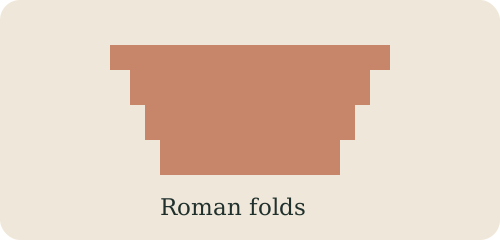
Representative mechanism illustration; exact construction varies by product.
At a glance
Mechanism: Fabric folds, bands or woven fibers stack, roll or traverse. Liner choice, fold depth, openness and stack space change how the treatment behaves.
Material/configuration: Sheer fabric layers with adjustable fabric vanes
Common operation: Cordless, continuous loop or motorized
Best uses: Soft daylight, adjustable light, formal living spaces
Concrete limitation: Limited blackout and more delicate cleaning than hard slats.
How this treatment behaves
Reasons to choose it
Textile construction offers broad style and privacy choices, with liners adding room darkening. Soft daylight, adjustable light, formal living spaces are the practical reasons to consider this construction.
Privacy and light control
Privacy: Liner, weave and vane alignment determine privacy; unlined natural fibers may show silhouettes.
Light control: Folds and liners soften daylight, but most fabric formats do not redirect light as precisely as tilted slats.
Blackout/room darkening: A blackout liner can help, while edge gaps and fold geometry still matter.
Thermal and room conditions
Insulation: Layering can add resistance near the glass, but the exact fabric and fit control the outcome.
Glare: Material, orientation, openness or slat/louver angle can change glare; verify the window’s sun exposure.
Moisture: Many textiles are poor choices near persistent condensation; verify the exact care and moisture guidance.
Configuration and care
Variation: Sheer fabric layers with adjustable fabric vanes; different materials and controls can change weight, durability and appearance.
Installation: Allow for stack depth, headrail clearance, handle swing and the chosen lift or motor.
Measurement: Record width, height, depth, trim, handles, stack/hinge clearance and control reach in more than one place.
Cleaning: Follow the fabric-specific method; aggressive scrubbing can damage fibers, folds or coatings.
Maintenance and durability: Cleaning, moisture exposure and stack depth can be more demanding than hard slats. Inspect moving parts and follow the exact care guide.
Children and pets: Use cordless or motorized controls. Keep cords and moving panels inaccessible; pets can damage fabric, slats or linkage.
Automation and retrofit: HIGH; LOW. The motor must match the physical motion, not just the treatment name.
Published performance notes
Upfront Affordability
Fabric folds, bands or woven fibers stack, roll or traverse. Liner choice, fold depth, openness and stack space change how the treatment behaves. In this comparison it is a limitation to check; the exact configuration and installation determine the practical outcome.
Detailed numeric rating is available in the published methodology and comparison record.
Durability
Cleaning, moisture exposure and stack depth can be more demanding than hard slats. In this comparison it is condition-dependent; construction, care and room conditions affect service life.
Detailed numeric rating is available in the published methodology and comparison record.
Closed Privacy
Liner, weave and vane alignment determine privacy; unlined natural fibers may show silhouettes. In this comparison it is condition-dependent; angle, opacity and edge gaps can change the result.
Detailed numeric rating is available in the published methodology and comparison record.
Adjustable Light Control
Fabric folds, bands or woven fibers stack, roll or traverse. Liner choice, fold depth, openness and stack space change how the treatment behaves. In this comparison it is often a strength; the exact configuration and installation determine the practical outcome.
Detailed numeric rating is available in the published methodology and comparison record.
Blackout Potential
A blackout liner can help, while edge gaps and fold geometry still matter. In this comparison it is a limitation to check; the exact mount and edge coverage matter.
Detailed numeric rating is available in the published methodology and comparison record.
Insulation Potential
Layering can add resistance near the glass, but the exact fabric and fit control the outcome. In this comparison it is a limitation to check; fit, material and installation conditions remain decisive.
Detailed numeric rating is available in the published methodology and comparison record.
Glare / UV Control
Folds and liners soften daylight, but most fabric formats do not redirect light as precisely as tilted slats. In this comparison it is often a strength; sun direction and fabric/slat configuration matter.
Detailed numeric rating is available in the published methodology and comparison record.
Moisture Resistance
Many textiles are poor choices near persistent condensation; verify the exact care and moisture guidance. In this comparison it is a limitation to check; verify the exact material rating.
Detailed numeric rating is available in the published methodology and comparison record.
Common questions
Is this type always the best choice?
No. Window geometry, room conditions, material, installation and maintenance can change the answer.
What should I verify before ordering?
Verify dimensions, mount depth, clearance, control safety, material, cleaning method, edge coverage and any exact automation compatibility.
What evidence supports this guide?
Important claims are linked below with publisher, source class, scope and verification date. Manufacturer material is labeled as manufacturer-stated.
Last reviewed: 2026-08-05 · Dataset evidence model 2.0.0.
Open a decision guide → · Read the methodology →