Home / Types / Roller Shades
Shades type guide
Roller Shades
A flat sheet of material rolls onto a tube, producing a simple profile and a wide range of opacity choices.
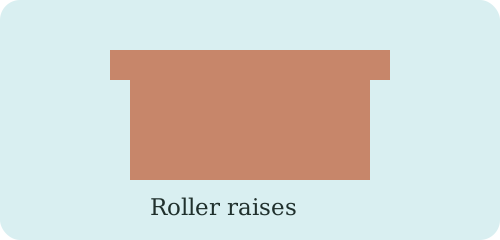
Representative mechanism illustration; exact construction varies by product.
At a glance
Mechanism: A flat fabric or screen rolls around a tube. Opacity, openness factor, hem bar, cassette/fascia, side channels and side gaps determine the practical result.
Material/configuration: Fabric, vinyl or screen material on roller tube
Common operation: Cordless spring, clutch chain, wand or motorized
Best uses: Budget flexibility, minimalist design, blackout fabrics, motorization
Concrete limitation: Side and top light gaps can limit total blackout; chain systems require safety compliance.
Automation availability: Widely available on selected products.
Retrofit potential: Strong retrofit potential for compatible chain-driven systems.
Performance highlights
Privacy and light control
Opaque fabrics can provide privacy; solar fabrics usually provide daytime privacy but can reverse at night when lights are on. Solar openness factor, fabric color and exterior conditions affect glare and view-through.
Concrete limitation: Sightlines and daylight change with the actual material, closure and mount.
Room darkening
Blackout fabric plus an outside mount, cassette or side channels can reduce leakage, but no category label guarantees darkness.
Concrete limitation: Edge coverage, headrail detail and mounting geometry can still admit light.
Thermal behavior
A roller can add a fabric layer, but it is not an air-cell system; fit and backing are decisive.
Concrete limitation: The glass, frame and installation gaps remain part of the result.
Moisture and care
Vinyl or explicitly moisture-rated fabrics are safer candidates than unverified textiles. Dust the fabric and tube gently; chains, hem bars and cassettes need product-specific cleaning.
Concrete limitation: Use only the care and moisture guidance published for the chosen product.
Installation and durability
Check tube width, bracket clearance, handle interference and whether the chosen mount covers the opening. A flat roller has limited directional-light control, and uncovered side gaps can admit light.
Concrete limitation: Measure the opening and moving obstructions before committing to a configuration.
The complete numeric model is available in the comparison methodology.
Last reviewed: 2026-08-05 · Dataset evidence model 2.0.0.