Home / Types / Vertical Blinds
Blinds type guide
Vertical Blinds
Vertical vanes rotate for light control and traverse sideways, making them practical for large openings.
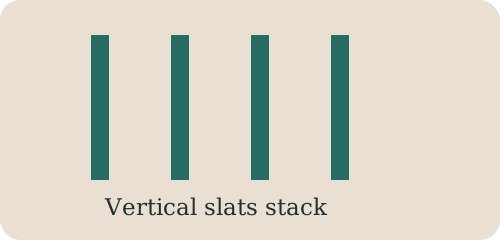
Representative mechanism illustration; exact construction varies by product.
At a glance
Mechanism: Vertical vanes rotate on carriers and traverse along a headrail. Stack-back, vane width, track condition and opening span govern use.
Material/configuration: Vinyl, fabric, composite or wood-look vanes
Common operation: Wand traverse/tilt or motorized on selected systems
Best uses: Sliding glass doors, wide windows, low-to-moderate cost
Concrete limitation: Vanes can separate or swing; appearance is more utilitarian for some users.
How this treatment behaves
Reasons to choose it
Side-to-side travel makes the format practical for wide windows and sliding doors. Sliding glass doors, wide windows, low-to-moderate cost are the practical reasons to consider this construction.
Privacy and light control
Privacy: Vane rotation changes sightlines, but gaps and stack-back expose portions of the opening.
Light control: Rotation gives useful control, though it is less precise when vanes are moving or stacked.
Blackout/room darkening: Specialty fabrics and overlap help; the headrail and side gaps remain weak points.
Thermal and room conditions
Insulation: The track and separated vanes leave more discontinuities than a close cellular or panel system.
Glare: Material, orientation, openness or slat/louver angle can change glare; verify the window’s sun exposure.
Moisture: Vinyl may tolerate damp areas better than fabric, subject to the exact product instructions.
Configuration and care
Variation: Vinyl, fabric, composite or wood-look vanes; different materials and controls can change weight, durability and appearance.
Installation: Confirm stack side, door handles, floor clearance and headrail support before ordering.
Measurement: Record width, height, depth, trim, handles, stack/hinge clearance and control reach in more than one place.
Cleaning: Dust vanes and keep carriers and the traverse track free of grit.
Maintenance and durability: Vanes can swing, separate or crease, and the track needs periodic cleaning and alignment. Inspect moving parts and follow the exact care guide.
Children and pets: Prefer wand-operated or safely motorized products. Keep cords and moving panels inaccessible; pets can damage fabric, slats or linkage.
Automation and retrofit: MEDIUM; LOW. The motor must match the physical motion, not just the treatment name.
Published performance notes
Upfront Affordability
Vertical vanes rotate on carriers and traverse along a headrail. Stack-back, vane width, track condition and opening span govern use. In this comparison it is often a strength; the exact configuration and installation determine the practical outcome.
Detailed numeric rating is available in the published methodology and comparison record.
Durability
Vanes can swing, separate or crease, and the track needs periodic cleaning and alignment. In this comparison it is condition-dependent; construction, care and room conditions affect service life.
Detailed numeric rating is available in the published methodology and comparison record.
Closed Privacy
Vane rotation changes sightlines, but gaps and stack-back expose portions of the opening. In this comparison it is condition-dependent; angle, opacity and edge gaps can change the result.
Detailed numeric rating is available in the published methodology and comparison record.
Adjustable Light Control
Vertical vanes rotate on carriers and traverse along a headrail. Stack-back, vane width, track condition and opening span govern use. In this comparison it is often a strength; the exact configuration and installation determine the practical outcome.
Detailed numeric rating is available in the published methodology and comparison record.
Blackout Potential
Specialty fabrics and overlap help; the headrail and side gaps remain weak points. In this comparison it is a limitation to check; the exact mount and edge coverage matter.
Detailed numeric rating is available in the published methodology and comparison record.
Insulation Potential
The track and separated vanes leave more discontinuities than a close cellular or panel system. In this comparison it is a limitation to check; fit, material and installation conditions remain decisive.
Detailed numeric rating is available in the published methodology and comparison record.
Glare / UV Control
Rotation gives useful control, though it is less precise when vanes are moving or stacked. In this comparison it is often a strength; sun direction and fabric/slat configuration matter.
Detailed numeric rating is available in the published methodology and comparison record.
Moisture Resistance
Vinyl may tolerate damp areas better than fabric, subject to the exact product instructions. In this comparison it is often a strength; verify the exact material rating.
Detailed numeric rating is available in the published methodology and comparison record.
Common questions
Is this type always the best choice?
No. Window geometry, room conditions, material, installation and maintenance can change the answer.
What should I verify before ordering?
Verify dimensions, mount depth, clearance, control safety, material, cleaning method, edge coverage and any exact automation compatibility.
What evidence supports this guide?
Important claims are linked below with publisher, source class, scope and verification date. Manufacturer material is labeled as manufacturer-stated.
Last reviewed: 2026-08-05 · Dataset evidence model 2.0.0.
Open a decision guide → · Read the methodology →